Monday, December 27, 2010

Color Spots On Bottom Of Beers

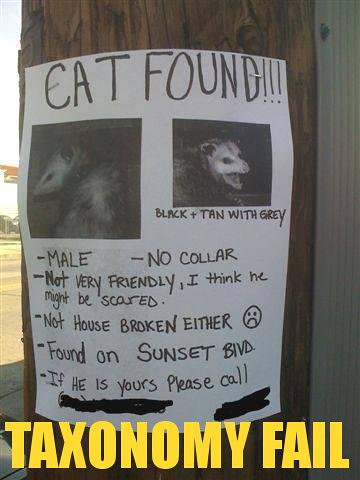
Taxonomy FAIL


frivoleria A funny (but it will be then so frivolous?) as a Christmas present: the "Fail Taxonomy Index" proposed in September by Alex Wild good on his blog MYRMECOS . He suggests to measure the severity of an identification error between a species A and species B in this way: divide the number of millions of years passed since A and B have separated from their last common ancestor for the number of millions of years since chimps and humans split from their last common ancestor. Mistaking a man for a chimpanzee is equivalent to an error of 1 on the TFI. Exchange, as here, a possum with a cat is 24.6 times worse. Exchanging a bee with a wasp scores a 25.2, and in the ass to all those who are unable to do so.

Happy Holidays!

Tuesday, December 21, 2010

Nhl Cool Helmet Designs

Spotlight Zoology: Tardigrada


As I had occasion to mention, the modern taxonomy is becoming increasingly complex, which only makes more and more remote the possibility that the peasants (you all) sooner or later acquire a minimal basis of this science, at least as we can tell the difference between a caterpillar and an anaconda. Even those few who have, in general culture, a smattering minimum, to stop gross division like "vertebrates vs. invertebrates" without imagining that vertebrates are in fact only a small fraction of the phylum that vanishes in a sea of \u200b\u200bother , larger and more numerous, from the family as the Arthropods and Mollusks than the almost unknown to the general public, such as tardigrades. But what they are, then, the tardigrades? Small creatures with eight short stubby legs nails, and a vaguely segmented body (they are a sister group of arthropods, in fact), who live almost everywhere in the world, but they are so small as to be invisible to the naked eye and can "swim" in that some moisture collected in mosses and lichens. What have they so special? Poliestremofili are: an extremophile is an organism that can survive a certain type of extreme conditions, so a poliestremofilo will be a body capable of resisting many types of extreme conditions. In fact, our tardigrades (for some reason in English called "water bears" even though more than a bear look like Jabba the Hutt) are considerably fucksters: they can survive very high temperatures (151 degrees) or near zero (-272) may hold out for ten years was dehydrated, can withstand a pressure of 1200 atmospheres, and can survive a dose of radiation more than 1000 times greater than that which would kill a man. The state of low metabolism, which owe their extraordinary superpowers criptobiosi is called, and has allowed some tardigrades to survive for ten days in space, where "space" is not understood in a spaceship, but in the open space, without air, food or water, freezing temperatures and rain radiation. In fact there is enough to suspect that any tardigrades is actually a tiny fragment of Chuck Norris, except that Chuck Norris can not be broken.

Mai.

Wednesday, December 15, 2010

Can Trade Soul Silver

Top Ten: The 10 new species of the coolest decade


documentaries in collaboration with Conservation International is a great time to choose their favorite ten species discovered in the last ten years. clicking here you can read the article in English and see the pictures, will report briefly the list below:

1) Tiburon granrojo: nicknamed "Big Red" is an abysmal medusona red one meter in diameter, thanks to the discovery 'use of underwater cameras.

2) Phobaeticus chani: more than half a meter long, is the insect (stick) longest in the world.

3) Rhynococyon udzungwensis: This elephant shrew has been discovered by an Italian. Woot! We are not always useless (only most of the time)!

4) Hemiscyllium Gale: the "bamboo shark, scientists have auctioned the right to give the name and used the funds in marine environmental protection.

5) Phragmipedium Kovach: huge pink orchid, discovered for the first time in illegal possession of a dealer of rare flowers.

6) Rungwecebus kipunji: not only a new species, but also the first new monkey genus discovered since 1920.

7) Nepenthes palawanensis: large pitcher plant pitcher plant (a "funnel")

8) Cyrtodactylus macrotuberculatus: There are two varieties of this gecko, a forest and a cave.

9) Bradypus pygmaeus: ... guess. It has evolved in just 9000 years of isolation on an island, a short time in the history of life on earth.

... Hey, they forgot to put the number 10! Oh, well. As you can see, the list is more of a fun, and the species were chosen, since the goal of "make a documentary, mostly based on what is visible: 5 vertebrates, invertebrates, 2 large, 2 large plants. Although it is true that finding new species of large organisms is rare and difficult, I'm sure many other species, far more strange and interesting, they could enter the list. And since the position was apparently vacant, I propose to assign the number ten spot in a brand new come, Synthia, the first synthetic organism, created this year by the work of Craig Venter. It will be artificial, but it is a new species, right? It seems to me that the second birth of life on this earth is not just stuff.
Thursday, December 2, 2010

Nike White Nike Freek Wrestling Shoes

The truth is good, maybe (and charismatic)


In fact usually I would say "The truth is good, ALWAYS" but I want to give the benefit of the doubt-raising technique used by most lots of charities to protect the environment. Let me explain. WWF, Greenpeace and so usually advertise their work with large pictures of leopards, pandas, elephants and other animals photogenic and popular, launching fundraising campaigns in the name of these animals and most often presenting as the incentive for nature conservation their beauty. This technique is the so-called "charismatic megafauna," that use "promotion" of known animals, big and spectacular to entice the public to make donations that then will be used to save whole ecosystems, not just the species in question. Now, if it comes to shell out some coin for a good cause a few hippies, middle-aged loosening the close on the portfolio only if the wave front of a picture of a tiger, there is nothing wrong with that. But this method to see and hear only what the people want to see and hear first of all, keeps people ignorant about the true, far more important reasons to donate (the salvation of entire ecosystems, property and made from it, in addition to their both waved, although effective, beauty) and the creatures that defend (newsflash: most of the components of an ecosystem has six legs and do not appear very well on the lovely Christmas cards I sent the WWF, but is nevertheless essential equally interesting and worthy of living on this world), and secondly alienates the sympathies of those who receive the message as a simple "nature is nice and hairy, let's help we?" and rightly says: "Chemmifrega?". If real news is divulged SCIENTIFIC the nature and importance of ecosystems and all their inhabitants not only as a source of beauty, but also as sources of knowledge, medicine, food, money and above all, like a house on which we depend, in my opinion it would increase the interest of anyone to make a donation. But if a nuisance is disappointed because for every tiger defending also saves millions of cockroaches, you fuck.

Only Westpoint Graduate W/o Demerit

A Bridge to the Stars


the wake of my recent considerations on the sixth great extinction is happening at the hands ours, it makes me reflect on the role of our species in the long history of life. Obviously, no organization was founded with an aim to make the universe, but it is inevitable that his life has an impact, in varying degrees, on other organisms. Various biological groups have indelibly marked the history of the earth: the cyanobacteria that altered the primordial atmosphere, making breathing for most of modern living groups, the first plants that made the land livable, arthropods that conquered and became part of each ecosystem, the dinosaurs, which were the dominant group of vertebrates for longer than any other. And then there is us, not as a group, but perhaps for the first time, as a single species, to cause an epochal event, the sixth great extinction. But our role should be only negative? Not necessarily. As I explained in the article, I think it unlikely that any major geological event or anthropogenic, however devastating, can erase all life, the only thing you can do is the total destruction of this planet, which will take place between 5 billion years when the Sun will end on fuel and we wrap you in an embrace of fire. Time there, but why not start now to provide for the highest goals, the escape from this world condemned flight that will make life that can expand from world to world and conquer the stars, effectively making them indestructible and filling the empty depths of the cosmos? Human science can certainly progress to be made possible the colonization of other planets, if not suffer a blow arrest because of the increasing stupidity of the population or of any mass mortality of which probably will be done if we continue to march on the route of 'extinction. 5 billion years is a long, our descendants may or totally different creatures, among the millions or billions of years, still widely in time to start thinking about the problem, but why not get busy in advance, why not be the first to take the biosphere into space and to make eternal life? The technology so far only a hypothesis of terraforming would be to make a livable planet unlivable, largely through the use of living things, made in the presence of the necessary resources to establish an ecosystem should be similar to Earth, making it habitable for humans. The road is certainly still very long, but definitely exciting, not only to expand the high ideal of life among the stars, but also in our own interest, such as growing population that needs space and resources.